
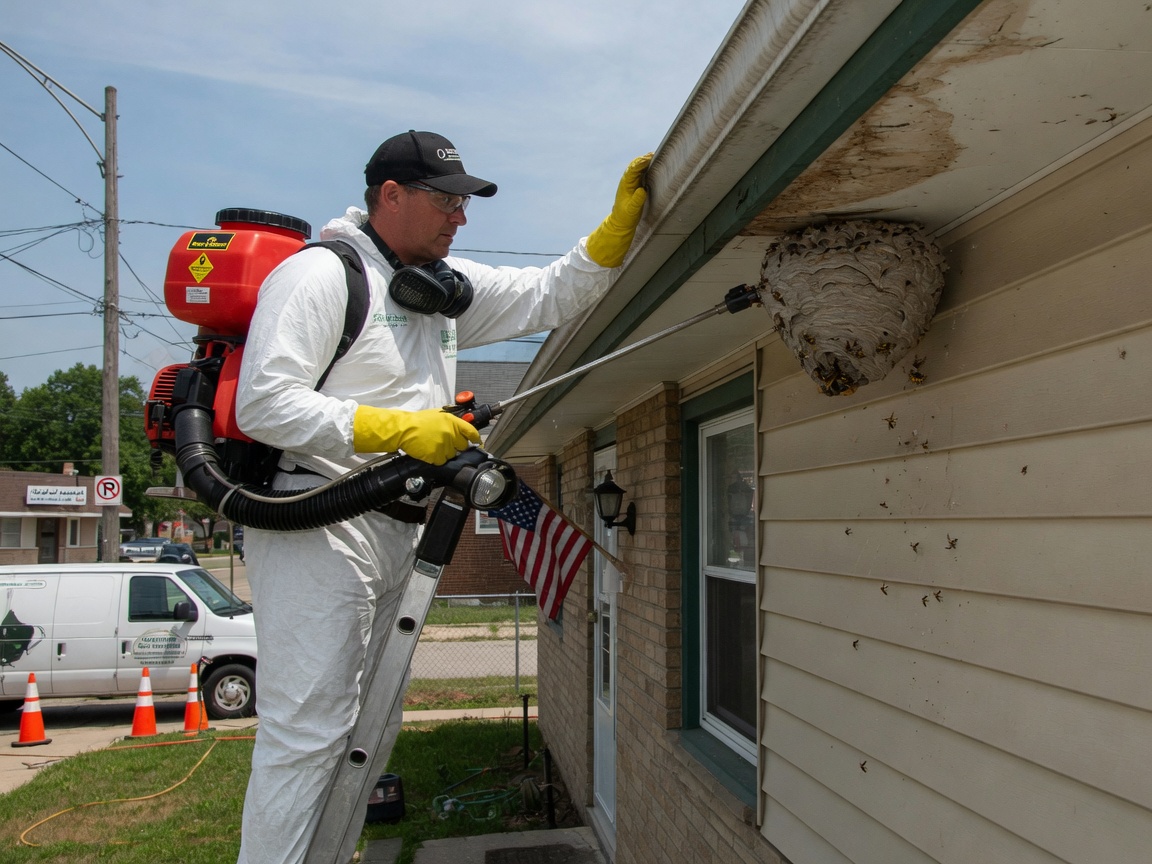
Dearborn homes built decades ago in East Dearborn and Fordson often feature deep eaves, brick veneer gaps and attic voids that paper wasps and yellow jackets favor once warm summer temperatures arrive. Cold snowy winters drive surviving queens indoors, so spring inspections around The Henry Ford area frequently turn up early nests tucked behind loose siding or in soffits. A single missed entry point can lead to colony growth by midsummer when outdoor activity peaks near the Arab American National Museum and surrounding neighborhoods.
Treatment here requires gel baits and dust applications that reach voids without soaking insulation, because older Wayne County construction rarely has modern vapor barriers. Ground nests appear more often in Taylor-adjacent yards with heavier clay soils that hold moisture after rain. Technicians working 24 hours from the Warren Avenue base know to check both the upper structure and any crawlspace access before declaring a property clear, especially after humid stretches that accelerate wasp foraging.
Removal steps include locating the primary nest, applying targeted insecticide at dusk when activity drops, then sealing exterior cracks to prevent re-entry. Homeowners in West Dearborn sometimes attempt aerosol sprays from big-box stores, which only scatters the colony into wall voids and creates follow-up calls. Local crews carry extension poles and borescopes sized for the narrow chase spaces common in 1950s and 1960s Dearborn housing stock.
Technician insight
In Dearborn, the thing that catches most people out with Wasp Control is how loose brick veneer on East Dearborn homes from the 1950s creates hidden voids that survive even heavy winter snow; one missed gap lets queens start new colonies every spring.
West Dearborn Eave Nest
Homeowner noticed wasps entering under second-story eaves after July heat. Inspection found two paper wasp nests inside a soffit gap common to 1960s brick construction. Treatment at dusk followed by sealing eliminated activity within two days.
Wasp Control Services We Offer
✓Paper Wasp Nest Removal
Locates and eliminates paper wasp colonies under eaves and porch ceilings common on older Dearborn homes in Fordson and East Dearborn.
✓Yellow Jacket Ground Nest Treatment
Treats subterranean yellow jacket nests found in yards and near foundations after warm summer rains in Wayne County.
✓Wasp Entry Point Sealing
Identifies and closes gaps around soffits, brick veneer and attic vents typical in West Dearborn brick homes to stop future nesting.
✓Commercial Wasp Control
Provides scheduled inspections and treatments for businesses near The Henry Ford and Greenfield Village where customer traffic increases sting risk.
✓Attic Wasp Inspection
Uses inspection tools to check attics and wall voids in older Dearborn homes where queens overwinter after cold snowy seasons.
Wasp Control Cost in Dearborn, MI
| Service | Typical Range | What Affects It |
|---|---|---|
| Single Visible Nest Removal | $175–$325 | Higher when nests are in second-story eaves of brick homes |
| Ground Nest Treatment | $150–$275 | Varies with soil conditions and proximity to structures |
| Attic or Void Inspection & Treatment | $225–$450 | Increases with multiple colonies or difficult access points |
| Entry Point Sealing Add-On | $75–$200 | Based on linear feet of gaps sealed on older siding |
Ranges are typical for Dearborn, MI and confirmed with an exact written quote before any work starts.
How it works
- 1
Site Assessment
Technician examines eaves, siding, attics and yard for active nests and entry points while noting construction details of the specific Dearborn neighborhood.
- 2
Targeted Treatment
Applies dust or gel products directly into the nest at dusk when wasps are less active, minimizing drift near homes and gardens.
- 3
Nest Removal
Physically removes the nest structure once activity ceases and vacuums any remaining insects from accessible voids.
- 4
Prevention Sealing
Closes identified gaps with appropriate materials suited to older Wayne County housing to reduce future wasp pressure.
Pricing
Cost depends on nest location, number of colonies and accessibility in older homes.