
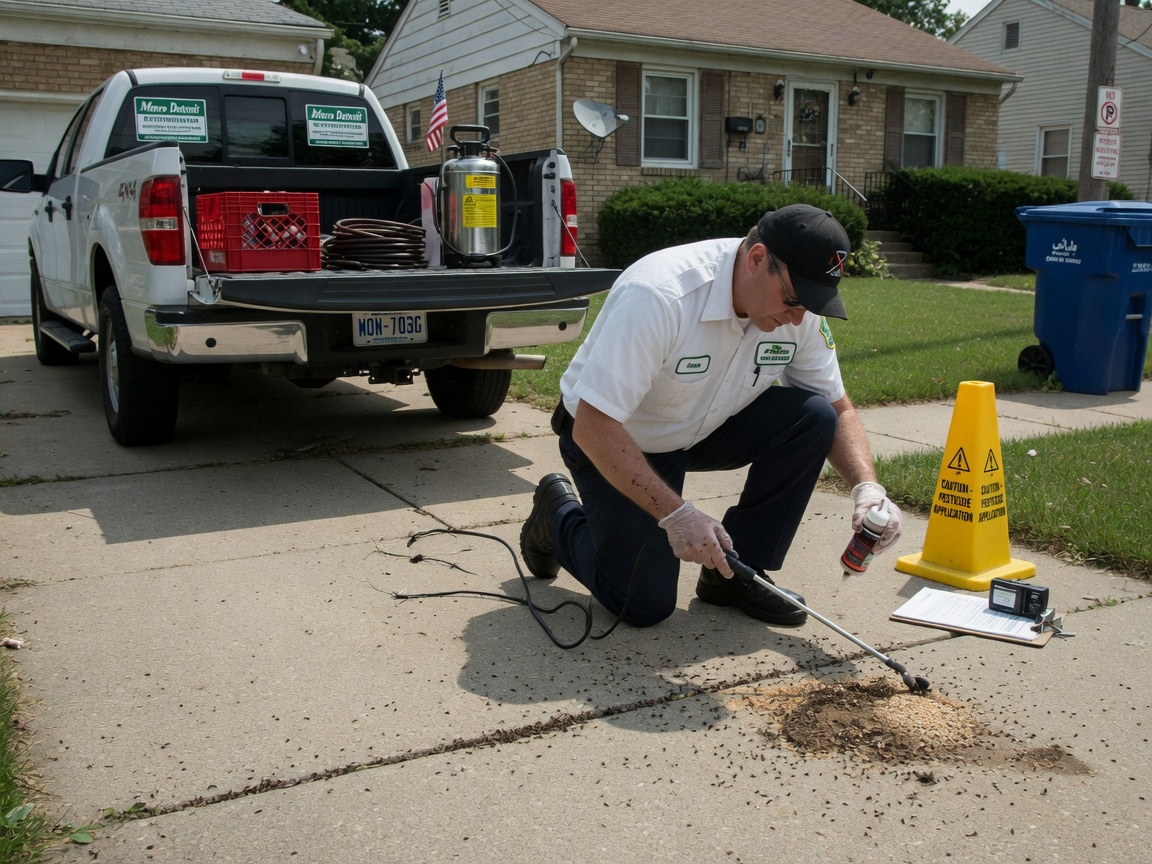
Dearborn's older brick and frame homes in East Dearborn and Fordson often sit on clay-heavy soil that holds spring meltwater, creating the exact moisture gradient carpenter ants follow when they move from decaying porch posts into wall voids. A single missed satellite colony behind plaster in these 1920s-1950s houses can re-infest within weeks if only the visible trail is sprayed. We map moisture trails first, then use non-repellent baits that workers carry back to the parent nest rather than perimeter sprays that scatter colonies into adjacent Taylor or Detroit blocks.
Winters that drop below zero drive pavement ants from sidewalk cracks into heated basements along Warren Avenue and around The Henry Ford campus. Once inside, they follow utility lines between units in multi-family buildings common near the Arab American National Museum. We treat the slab edges and expansion joints with targeted dusts instead of fogging, because fog leaves the colony intact under the concrete and the problem returns the next warm spell.
Humid summers increase pharaoh ant activity in commercial kitchens and older apartments throughout West Dearborn. These ants split colonies when disturbed, so broadcast sprays make the problem worse. We use slow-acting baits placed at active junctions only after confirming the species with a hand lens, then seal entry points around pipe penetrations that older Dearborn plumbing leaves exposed.
Technician insight
In Dearborn the thing that catches most people out with ant jobs is how the clay soil around 1920s-1950s homes in East Dearborn and Fordson holds water right against the foundation; once that happens, carpenter ants treat the sill plate like a highway and the usual perimeter spray just pushes them deeper into the walls.
East Dearborn porch colony
Homeowner in East Dearborn noticed ants on the kitchen counter each morning. Inspection found a parent nest in the front porch post that had extended into the sill plate. We placed non-repellent bait stations at the base of the post and along the foundation line, then returned after ten days to confirm the trail had stopped and no new activity appeared inside the house.
Ant Exterminator Services We Offer
✓Carpenter Ant Colony Elimination
Locates and treats parent and satellite nests inside wall voids and porch structures common in East Dearborn's older homes using non-repellent baits that workers carry back.
✓Pavement Ant Slab Treatment
Targets colonies living under sidewalks and basement slabs in Fordson and West Dearborn by applying dusts and baits at expansion joints without scattering the nest.
✓Pharaoh Ant Baiting Program
Deploys multiple bait stations in commercial and multi-unit buildings to eliminate budding colonies without triggering the split response that sprays cause.
✓Ant Entry Point Sealing
Identifies and closes gaps around utility lines, foundation cracks, and window frames that allow ants to move from soil into heated spaces during cold Wayne County winters.
✓Emergency Ant Infestation Response
Provides same-day inspection and initial bait placement for active trails reported in kitchens or basements anywhere in Dearborn or nearby Taylor.
Ant Exterminator Cost in Dearborn, MI
| Service | Typical Range | What Affects It |
|---|---|---|
| Single-family home inspection and initial treatment | $175–$325 | Higher when carpenter ants require wall void work in multi-story homes |
| Multi-unit or commercial building | $275–$550 | Varies with number of units and shared wall access needed |
| Follow-up visit | $75–$125 | Included if scheduled within 14 days of initial service |
| Entry point sealing add-on | $150–$300 | Based on linear feet of gaps around pipes and foundation |
Ranges are typical for Dearborn, MI and confirmed with an exact written quote before any work starts.
How it works
- 1
Property Inspection
Walk the full interior and exterior, checking moisture-prone areas, foundation lines, and utility entries typical of Dearborn's older housing stock.
- 2
Species Identification
Confirm ant type on site so treatment matches the nesting habits of carpenter, pavement, or pharaoh ants found in Wayne County.
- 3
Targeted Treatment
Place baits and dusts at active trails and nest locations rather than broadcasting product that can scatter colonies.
- 4
Follow-Up Monitoring
Return within 10-14 days to check bait consumption and re-treat any remaining activity before closing the job.
Pricing
Pricing depends on property size, number of colonies, and whether interior wall access is required.