
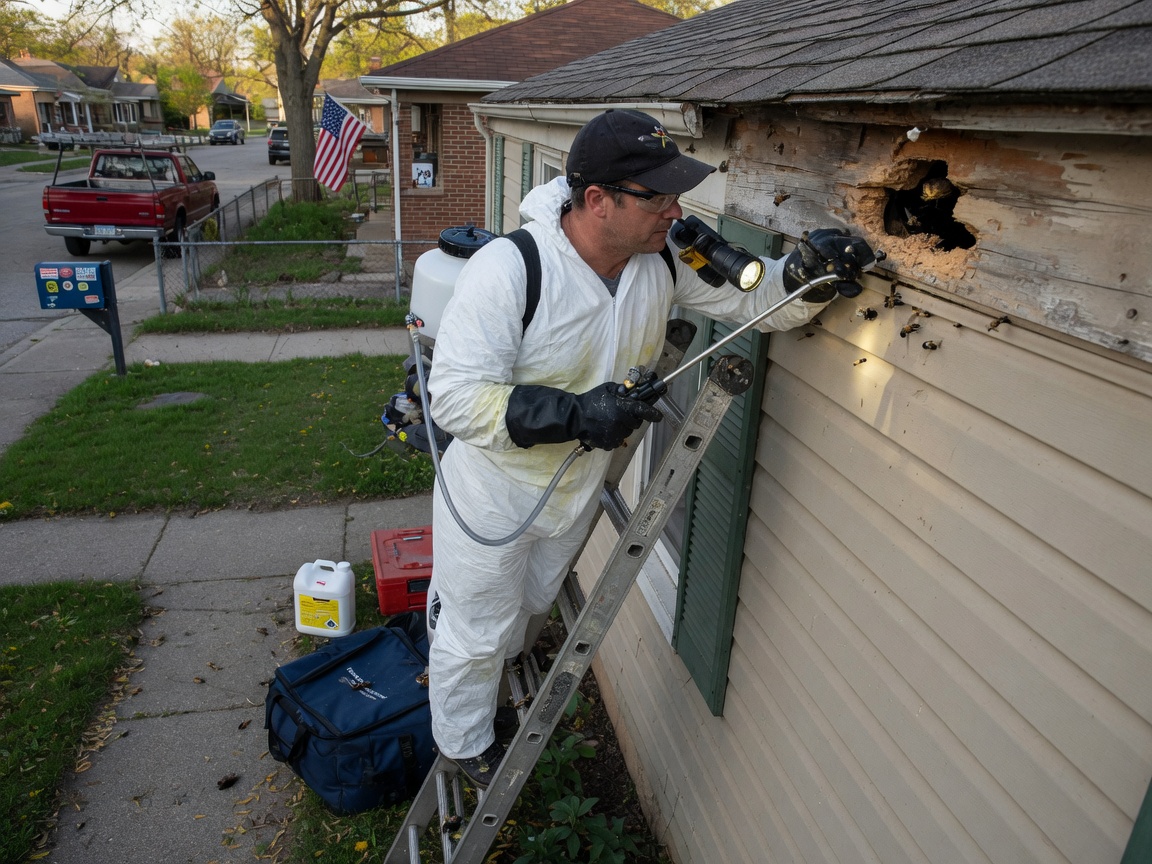
Carpenter bees appear each spring in Dearborn after snowy winters end and temperatures rise, targeting softwoods like cedar trim and pine porch ceilings common on 1920s-1950s homes in West Dearborn and Fordson. They bore perfectly round entry holes without eating the wood, creating tunnels that weaken fascia boards and eaves over time. Treatments focus on residual dusts applied directly into active holes plus perimeter sprays on unpainted surfaces, since these bees avoid painted or pressure-treated lumber that dominates newer builds near The Henry Ford.
In East Dearborn and areas bordering Detroit, dense tree cover and older detached garages increase encounters because carpenter bees prefer sun-exposed but sheltered wood near flowering shrubs. Sealing holes with caulk or plugs after treatment prevents reuse, yet new bees may arrive the following season if nearby properties remain untreated. Wayne County humidity in summer accelerates mold inside abandoned tunnels, so inspections check for secondary damage before recommending structural repairs.
Edge cases include second-story soffits on two-family homes near Greenfield Village where ladder access is limited and bees have already dropped frass onto parked vehicles. Commercial jobs at small retail strips along Warren Avenue often involve shared walls, requiring coordinated timing to avoid drifting dust into neighboring units. Follow-up visits two weeks later confirm no new activity, especially after warm spells that trigger additional emergence.
Technician insight
In Dearborn the thing that catches most people out with carpenter bees is the cedar fascia and pine porch ceilings on 1930s homes in Fordson and near the Arab American National Museum; once bees start there the tunnels run parallel to the grain and homeowners often miss them until frass piles up on driveways after spring rains.
Fordson porch ceiling infestation
Homeowner in Fordson noticed fresh sawdust on the front porch each morning after warm days. Inspection found six active holes in the cedar tongue-and-groove ceiling of a 1940s addition. Dust was applied into each tunnel, holes were sealed, and a perimeter spray protected adjacent unpainted rafters. No new activity appeared on the follow-up visit two weeks later.
Carpenter Bees Exterminator Services We Offer
✓Active Hole Treatment
Dust application directly into carpenter bee tunnels followed by sealing to stop further boring in porch ceilings and fascia.
✓Wood Surface Perimeter Spray
Residual insecticide applied to unpainted trim and eaves to deter new bees from starting holes on older Dearborn homes.
✓Frass and Damage Inspection
Detailed check of attics, garages and outbuildings to locate hidden tunnels and assess structural impact before treatment.
✓Preventive Wood Coating
Application of paint or stain to exposed softwood surfaces that carpenter bees target in West Dearborn and Fordson neighborhoods.
✓Seasonal Monitoring Visit
Spring and early summer re-inspection to catch new activity triggered by warm weather after cold winters.
Carpenter Bees Exterminator Cost in Dearborn, MI
| Service | Typical Range | What Affects It |
|---|---|---|
| Single-family home initial treatment | $225–$450 | Varies with porch size and second-story access in older Dearborn neighborhoods. |
| Multi-unit or garage add-on | $125–$275 | Added when separate structures require treatment. |
| Follow-up visit | $125–$200 | Scheduled two weeks later if new activity appears after warm weather. |
| Preventive coating application | $175–$350 | Depends on square footage of unpainted trim needing protection. |
Ranges are typical for Dearborn, MI and confirmed with an exact written quote before any work starts.
How it works
- 1
Site Inspection
Walk the exterior and accessible attic spaces of the Dearborn property to locate active holes and assess wood condition.
- 2
Targeted Treatment
Apply dust into tunnels and spray perimeter areas while avoiding painted surfaces that bees naturally avoid.
- 3
Hole Sealing
Plug treated entrances with wood putty or caulk once activity stops to prevent reuse by future bees.
- 4
Follow-Up Check
Return after two weeks to confirm no new boring and discuss preventive coatings for vulnerable trim.
Pricing
Upfront quotes based on number of structures, height of work areas and extent of active holes in Wayne County homes.